
HOW THE HOPE REGISTRY WORKS
Operation Bangladesh initiative by Shaker Global Poverty Reduction, founded by Morad Shaker, driving humanitarian impact worldwide in HOW THE HOPE REGISTRY WORKS.
🌍 HOW THE HOPE REGISTRY WORKS
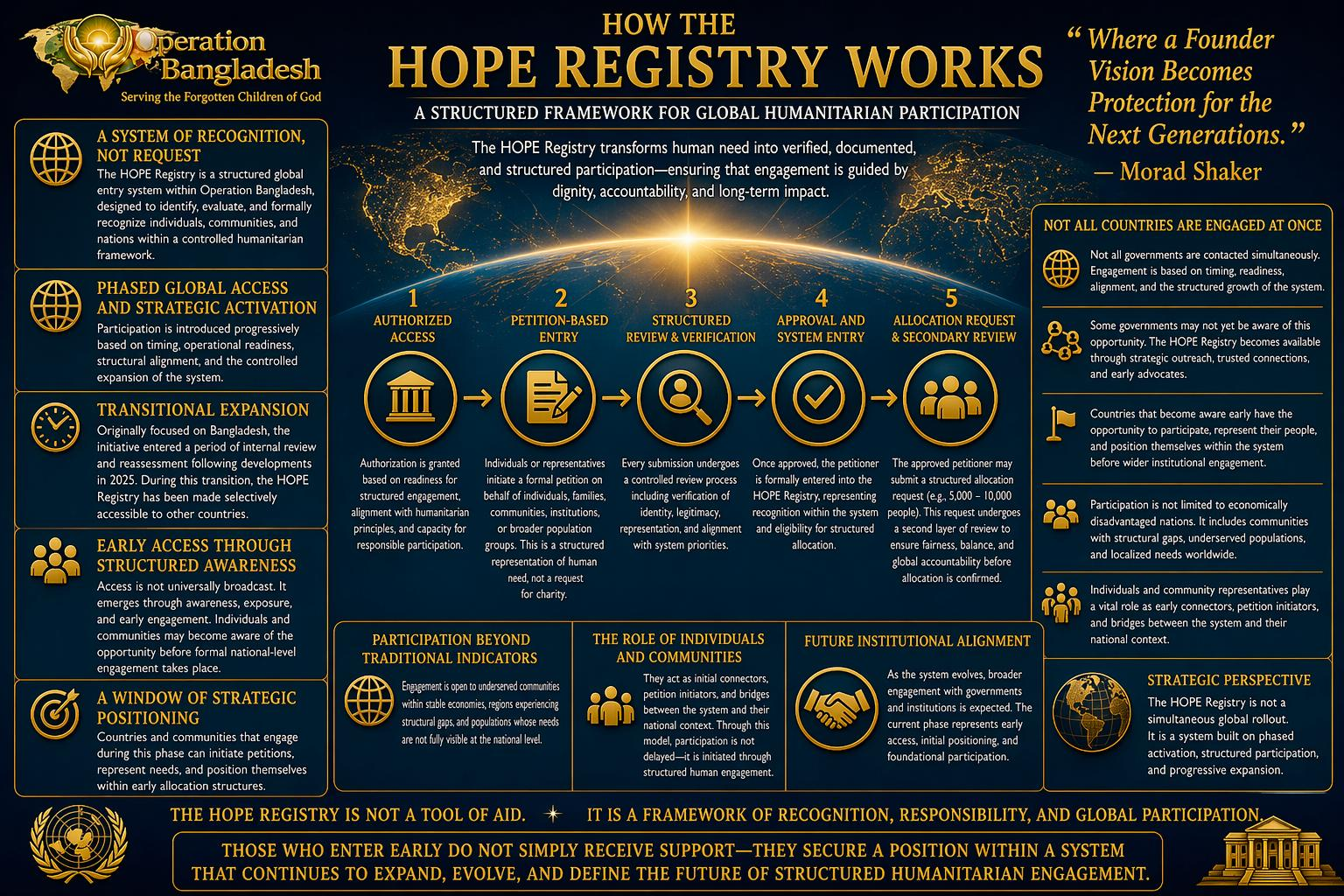
A Structured Framework for Global Humanitarian Participation
A System of Recognition, Not Request
The HOPE Registry is a structured global entry system within Operation Bangladesh, designed to identify, evaluate, and formally recognize individuals, communities, and nations within a controlled humanitarian framework.
It is not a platform for informal requests.
It is a system through which human need is transformed into verified, documented, and structured participation.
The purpose is clear: to ensure that engagement is guided by dignity, accountability, and long-term impact, rather than temporary or unstructured aid.
Phased Global Access and Strategic Activation
The HOPE Registry operates through a phased global access model.
Participation is not introduced simultaneously across all countries. Instead, engagement is activated progressively, based on:
- timing
- operational readiness
- structural alignment
- and the controlled expansion of the system
This approach preserves institutional integrity and ensures that each phase of growth remains stable, measurable, and globally accountable.
Transitional Expansion Beyond the Original Scope
Operation Bangladesh was originally designed with a primary focus on Bangladesh.
However, following developments that required extended internal review and structural reassessment, full-scale activation within its original scope entered a period of evaluation.
During this transition, the HOPE Registry has been made selectively accessible to other countries under a controlled expansion model.
This phase should be understood not as a departure from the original vision, but as an adaptive continuation of it under evolving conditions.
Early Access Through Structured Awareness
At this stage, access to the HOPE Registry is not universally broadcast.
Instead, participation emerges through:
- awareness
- exposure
- and early engagement
In many cases, individuals or community representatives become aware of the opportunity before formal national-level engagement takes place.
This creates a bridge between early participation and future institutional alignment.
A Window of Strategic Positioning
Countries and communities that engage during this phase are able to:
- initiate structured petitions
- represent localized needs
- and position themselves within early allocation structures
This does not replace future government-level coordination. However, it can influence how and when broader national participation is established.
Participation Beyond Traditional Indicators
Engagement in the HOPE Registry is not limited to countries defined by economic hardship.
Participation may include:
- underserved communities within stable economies
- regions experiencing structural gaps
- populations whose needs are not fully visible at the national level
This ensures the system remains inclusive, adaptive, and grounded in real-world conditions.
Step 1 — Authorized Access
A country enters the system through authorized access, granted under the direction of the Founder.
Authorization is based on:
- readiness for structured engagement
- alignment with humanitarian principles
- capacity for responsible participation
This ensures that the system operates with discipline and respect for national structures.
Step 2 — Petition-Based Entry
Once access is enabled, individuals or representatives may initiate a formal petition.
This petition represents:
- individuals
- families
- communities
- institutions
- or broader population groups
It is not a request for charity, but a structured representation of human need.
Step 3 — Structured Review and Verification
All petitions undergo a controlled review process, including:
- identity and contextual verification
- legitimacy and representation checks
- alignment with system priorities
The objective is to ensure that every approved entry reflects authentic need, credibility, and dignity.
Step 4 — Approval and System Entry
Once approved, the petitioner is formally entered into the HOPE Registry.
This represents:
- recognition within the system
- eligibility for structured allocation
- inclusion in a monitored global framework
At this stage, the participant becomes part of an active system, not a passive list.
Step 5 — Allocation Request and Secondary Review
Following approval, the petitioner may submit a structured allocation request.
This includes:
- the number of individuals represented (e.g., 5,000 – 10,000)
- scope and justification of need
This request undergoes a second layer of review to ensure fairness, balance, and global accountability.
Only after confirmation is allocation formally assigned.
Final Statement
The HOPE Registry is not a tool of aid.
It is a framework of recognition, responsibility, and global participation.
And those who enter early do not simply receive support—they secure a position within a system that continues to expand, evolve, and define the future of structured humanitarian engagement.