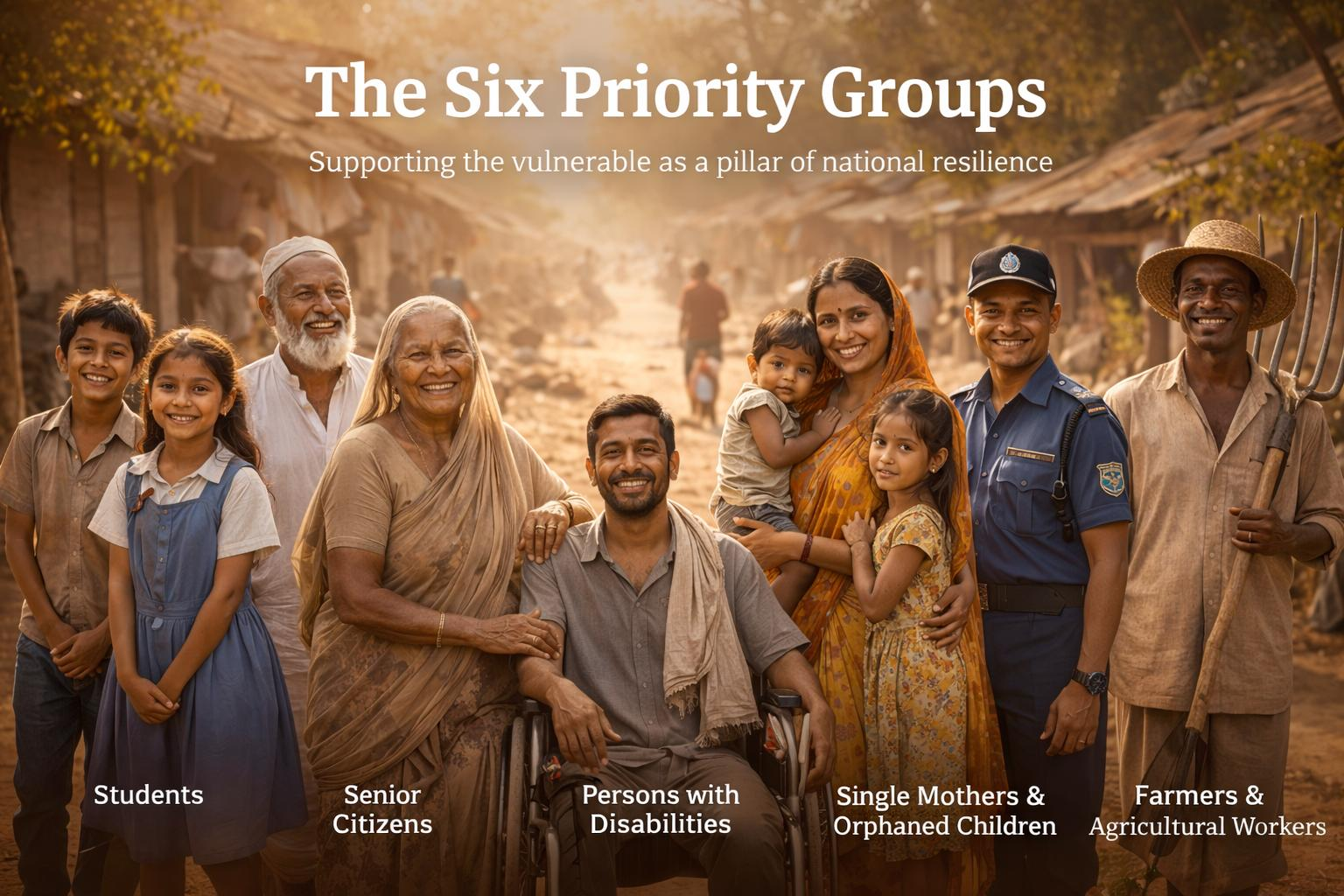
The Six Priority Groups
Operation Bangladesh initiative by Shaker Global Poverty Reduction, founded by Morad Shaker, empowering communities through global programs in The Six Priority Groups.
The Six Priority Groups
Operation Bangladesh exists because poverty is never abstract — it is lived.
For societies to remain stable, resilient, and humane, leaders must recognize the human beings behind statistics: individuals whose dignity, opportunity, and well-being are constrained not by lack of effort, but by circumstance.
Through careful observation, respectful engagement, and lived understanding of human need, Operation Bangladesh has identified six priority groups that form the permanent humanitarian foundation of this initiative.
These groups represent essential pillars of every society. Supporting them strengthens not only individual lives, but the entire national fabric.
🎓 1. Students — Protecting the Future
Ensuring education is never interrupted by hardship or economic pressure.
Students carry a nation’s promise.
Yet for many, education is fragile — disrupted by economic pressure and lack of support. Operation Bangladesh supports students so that learning is never sacrificed to hardship and every child retains the chance to develop their potential.
Supporting students is not charity. It is an investment in the future capacity of the nation.
🧓 2. Senior Citizens — Honoring a Lifetime of Contribution
Preserving dignity, care, and security in later stages of life.
Senior citizens carry the history, values, and wisdom of their communities.
Too often, they face old age without security or care. Operation Bangladesh supports senior citizens so they may live with dignity, stability, and peace — not as dependents, but as respected members of society.
Honoring elders reflects the moral maturity of a nation.
♿ 3. Persons with Disabilities — Advancing Inclusion and Respect
Removing barriers so every individual can participate fully in society.
Persons with disabilities face challenges that extend beyond physical limitation — including exclusion, limited access, and systemic neglect.
Operation Bangladesh supports these individuals through inclusion, respect, and opportunity — enabling participation, independence, and human dignity.
A society that includes all its people is a society that grows stronger.
👩👧 4. Single Mothers & Orphaned Children — Restoring Family Stability
Protecting families where vulnerability is greatest.
Single mothers and orphaned children often carry an unequal burden of responsibility and vulnerability.
Operation Bangladesh supports these families so children may grow in security and possibility, and caregivers are not left to carry the weight alone.
Protecting families protects the future of society itself.
🏛️ 5. Government Employees (Education Sector & Disciplinary Police Forces) — Sustaining Those Who Serve
Supporting those who uphold order, education, and public trust.
Educators and disciplinary public servants, including police personnel, are essential to social stability and national continuity.
Many serve with integrity while facing economic pressure that weakens morale and effectiveness. Operation Bangladesh supports these individuals so service is met with dignity, stability, and respect.
Strengthening those who serve strengthens the nation.
🌾 6. Farmers & Agricultural Workers — Securing the Roots of Daily Life
Safeguarding food security and rural livelihoods.
Farmers and agricultural workers sustain societies at their most fundamental level.
Yet many struggle without access to stability, resources, or opportunity. Operation Bangladesh supports farmers so they can thrive, sustain their families, and contribute to long-term food security and national resilience.
A nation that protects its farmers protects its future.
A Permanent Foundation — Designed to Adapt
These six priority groups form the permanent humanitarian foundation of Operation Bangladesh in every country of operation.
At the same time, the mission recognizes that no two nations experience poverty in exactly the same way.
For this reason, Operation Bangladesh was designed as a flexible and adaptive framework. Based on country-specific conditions and responsible consultation with national leadership, additional vulnerable groups may be identified and included.
In certain contexts, the program may expand beyond six groups — up to ten distinct groups, or more — ensuring that no population in genuine need is excluded due to rigid categorization.
This approach allows Operation Bangladesh to remain principled, consistent, and responsive — applying compassion intelligently and responsibly.
A nation’s strength is revealed not by the comfort of its fortunate, but by the dignity, protection, and opportunity it provides to those who need it most.