Hope Registry — Overview
Operation Bangladesh initiative by Shaker Global Poverty Reduction, founded by Morad Shaker, empowering communities through global programs in Hope Registry — Overview.
Hope Registry — Overview
The Hope Registry is a secure, pre-screening and intake system designed to identify, organize, and prepare humanitarian requests for integration into the forthcoming Shaker Global Poverty Reduction Ecosystem.
Developed as part of Operation Bangladesh, within the broader global framework, the Hope Registry serves as a transitional and preparatory platform, enabling structured participation while large-scale infrastructure continues to advance toward full deployment.
Allocation Framework and Initial Deployment
The Hope Registry serves as the initial allocation mechanism for participation within Operation Bangladesh, which was originally designed to support up to five million qualified individuals through structured humanitarian engagement.
In the current phase, this allocation is being activated through a controlled, multi-regional process. Qualified candidates and community representatives from multiple countries are now able to participate through the Hope Registry, subject to structured review and approval.
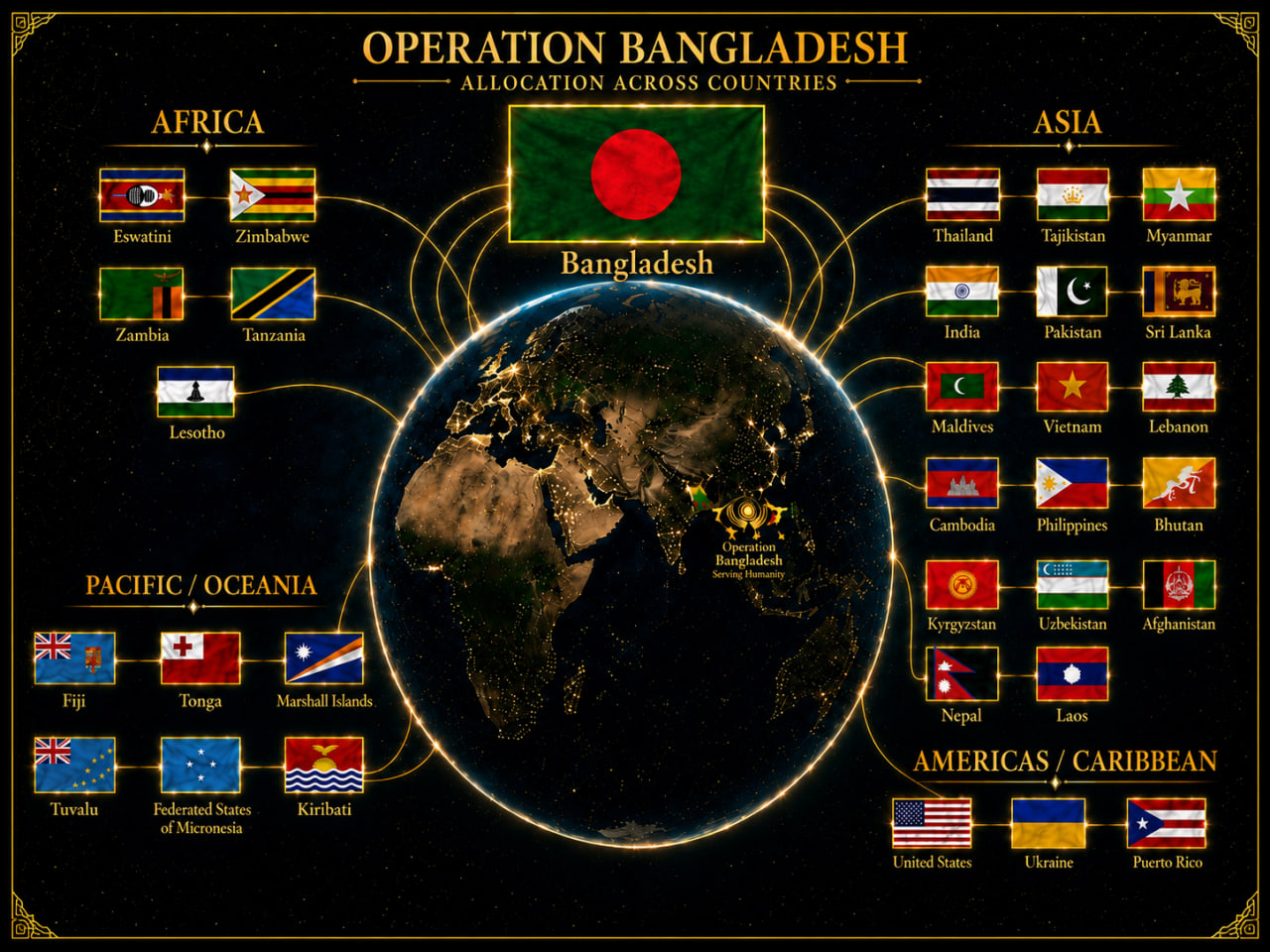
Each approved entry represents a placement within the overall five million capacity of Operation Bangladesh. As participation expands across regions—including emerging activity from countries such as Lebanon, Tajikistan, Thailand, and others—these placements are distributed within a unified and finite allocation framework.
This approach ensures that access remains structured, selective, and aligned with the original operational capacity, while enabling responsible participation across multiple regions.
Purpose and Strategic Role
The Hope Registry functions as a waiting list and pre-qualification system, allowing individuals, communities, and representatives to formally present humanitarian needs in a structured and reviewable format.
Through this system:
- Requests are organized into clear, verifiable submissions
- Participants are pre-screened for future integration
- Early-stage petitions are initiated and observed
This ensures that when the full ecosystem becomes operational, qualified and structured entries are already in place, enabling immediate and scalable engagement.
A Shift in Access: From Centralized to Participatory
While the long-term vision of the ecosystem includes engagement at institutional and governmental levels, the Hope Registry introduces a parallel access pathway.
Through this model:
- Individuals may act on behalf of their communities
- Representatives may initiate requests for groups or institutions
- Citizens are empowered to bring forward needs within their regions
This reflects a broader principle:
Structured humanitarian access should be responsibly enabled at both institutional and community levels.
The Hope Registry therefore serves as a bottom-up activation layer, complementing future top-down engagement.
From Single-Country Deployment to Multi-Regional Activation
At its initial conception, Operation Bangladesh was designed for large-scale, concentrated deployment, with the objective of reaching millions within underserved communities through coordinated national implementation.
Under that model, a centralized rollout would have enabled direct execution without the need for preliminary intake systems such as the Hope Registry.
However, as implementation remains under ongoing evaluation and institutional alignment, a strategic decision was made to introduce a controlled and structured access pathway.
The Hope Registry now enables measured participation while broader frameworks continue to be finalized, ensuring continuity without delay.
Regional Expansion and Structured Allocation
As a result, participation has expanded beyond a single-country focus and is now distributed across multiple regions under a controlled allocation model.
Through this process:
- Opportunities originally designed for concentrated deployment are being extended across multiple countries
- Early participation is emerging in regions such as Thailand, Sri Lanka, Maldives, and other developing areas
- Additional requests continue to be received from across Asia and beyond
This transition reflects a broader operational reality:
Scalable humanitarian systems must adapt dynamically, ensuring that readiness, structure, and participation remain aligned.
Expanded Eligibility Through Strategic Reallocation
As the system evolves into a multi-regional framework, eligibility has also expanded.
Under the original design, participation was aligned with specific economic and demographic thresholds, prioritizing regions with the highest concentration of large-scale need.
However, as structured allocation has been distributed across multiple countries, the Hope Registry now enables participation from regions that may not have been included under the initial framework.
Through this transition:
- Access is no longer confined to a single national context
- Opportunities are extended across a broader range of communities
- Regions with varying economic profiles are now able to engage within a structured system
When large-scale systems transition from concentrated deployment to distributed activation, access expands—and new participants emerge.
Integrity, Structure, and Controlled Access
- Access is provided through secure registration
- Submissions are reviewed prior to activation
- Participation follows defined structural guidelines
This ensures that all activity within the system maintains credibility, clarity, and accountability.
From Pre-Screening to Full Integration
The Hope Registry represents the first stage in a broader operational process.
Once a submission is accepted:
- It may be formalized into a structured petition
- The case enters a review and observation phase
- It becomes eligible for transition into the full ecosystem
This progression allows the system to move from:
Identification → Pre-Screening → Structured Readiness → Future Integration
A Living, Multi-Regional System
The Hope Registry operates as a dynamic and evolving platform, reflecting real-time participation across regions.
Through the Global Activity interface, users can observe:
- Active countries and emerging regions
- Petitions at various stages
- Ongoing developments across the system
This transparency reinforces the registry’s role as a living humanitarian infrastructure, preparing for large-scale deployment.
Access and Participation
Access to the Hope Registry is provided through a secure and controlled login environment.
Approved participants may:
- Create and manage structured profiles
- Submit and develop petitions
- Represent communities, institutions, or groups
Public users may observe high-level activity, while deeper interaction remains restricted to authorized participants.
Position Within the Broader Framework
- Global Movement → Vision, expansion, and global presence
- Hope Registry → Structured access and early-stage participation
- Shaker Global Poverty Reduction Ecosystem → Full-scale execution
Together, they form a cohesive model for scalable, structured humanitarian engagement across regions.
Closing Statement
The Hope Registry represents a deliberate shift toward a more adaptive, inclusive, and scalable approach to humanitarian access.
It is not simply a waiting list.
It is a preparatory system, designed to organize participation, enable structured entry, and extend opportunity across regions—while advancing toward full global implementation.