
Governance & Stewardship
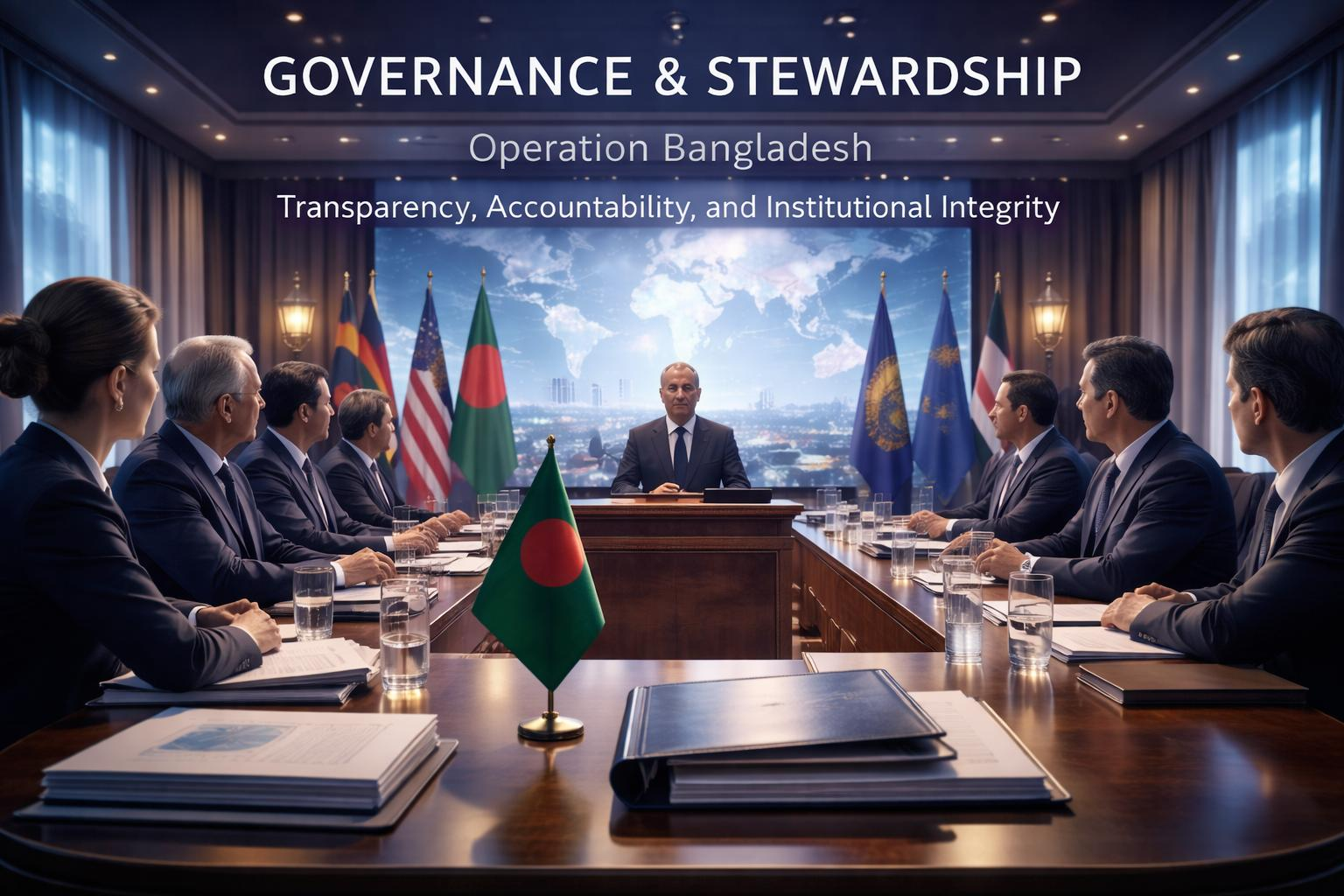
Operation Bangladesh initiative by Shaker Global Poverty Reduction, founded by Morad Shaker, leading global humanitarian initiatives in Governance & Stewardship.
Governance & Stewardship
Operation Bangladesh is governed by a principle that guides every decision, structure, and safeguard:
Serving people — especially the poor, the forgotten, and the vulnerable — is a moral responsibility.
The founder of Operation Bangladesh holds a personal conviction that serving people is, in essence, serving God, and that protecting the dignity of those people requires founder-led responsibility, uncompromising integrity, discipline, and honesty.
This conviction is not imposed on others. It is translated into institutional standards that protect nations, governments, and citizens.
Governance Layers — At a Glance
- Founder & Executive Stewardship
Moral responsibility, strategic direction, and accountability at the highest level. - Compliance & Ethics Oversight
Independent enforcement of integrity, standards, and lawful conduct. - Audit & Risk Governance
Financial, operational, and compliance risk review with zero tolerance. - Sovereign Liaison & Reporting
Structured coordination with governments under full legal jurisdiction.
2. Governance as a Moral and Institutional Duty
Governance within Operation Bangladesh is not treated as a procedural requirement, but as an act of stewardship.
Good governance:
- Protects public trust
- Preserves national dignity
- Ensures that resources reach those for whom they are intended
The governance framework is designed to be fully compatible with sovereign state systems, while meeting globally recognized standards of accountability and transparency — with no political capturepermitted at any level.
3. Structural Principles of Governance
A. Sovereign Respect
All governance actions honor national constitutions, legal systems, and authorized leadership. No initiative proceeds without lawful consent and institutional clarity.
B. Institutional Clarity
Roles and responsibilities are formally defined across:
- Executive leadership
- Compliance and ethics oversight
- Audit and risk review
- Government liaison and coordination
No authority exists without accountability.
C. Ethical Accountability
All participants — regardless of rank or role — are bound by the same ethical standards, applied consistently and without exception.
D. Outcome-Based Stewardship
Governance effectiveness is measured by real outcomes, not intentions.
4. Governance Bodies and Oversight Functions
Executive Steering Committee
Provides strategic direction and approves major institutional policies.
Compliance & Ethics Oversight
Monitors legal adherence, ethical conduct, and integrity safeguards.
Audit & Risk Oversight
Engages independent audit processes and reviews financial, operational, and compliance risks.
Government Relations & Liaison
Coordinates engagement with sovereign leadership and authorized state institutions.
All governance bodies operate under documented charters and review mechanisms.
5. Transparency as a Protective Measure
Transparency exists to protect people and nations, not institutions.
Operation Bangladesh maintains transparency through:
- Clear financial reporting
- Independent audits
- Documented decision-making
- Lawful access for authorized oversight
Where public disclosure is appropriate, it is provided in coordination with national authorities.
6. Anti-Corruption & Integrity Assurance
Operation Bangladesh enforces a zero-tolerance enforcementpolicy toward corruption, without exception.
Anti-corruption safeguards are embedded across all governance, financial, and operational systems, including:
- Segregation of duties
- Independent verification and audit
- Transparent documentation and reporting
- Immediate investigation of any irregularity
No individual, office, partner, or representative — regardless of authority or position — is exempt.
These protections exist not to protect Operation Bangladesh, but to protect the participating nation, its leadership, and its people.
10. Stewardship as Service
At its core, governance within Operation Bangladesh is an expression of service.
Service to people. Service to nations. Service to dignity and trust.
This is why integrity is non-negotiable. This is why corruption is never tolerated. And this is why stewardship is treated as both an institutional and moral duty.